

 From the studio stove · 7 a.m.

The Iron Kettle on the Studio Stove, and the Packet Dee Left Beside It
A retired potter blanks on a thirty-year customer's name, and a friend with mushrooms in her garage leaves a box on his wedging table. The label, the research and the caffeine, read like a glaze recipe.
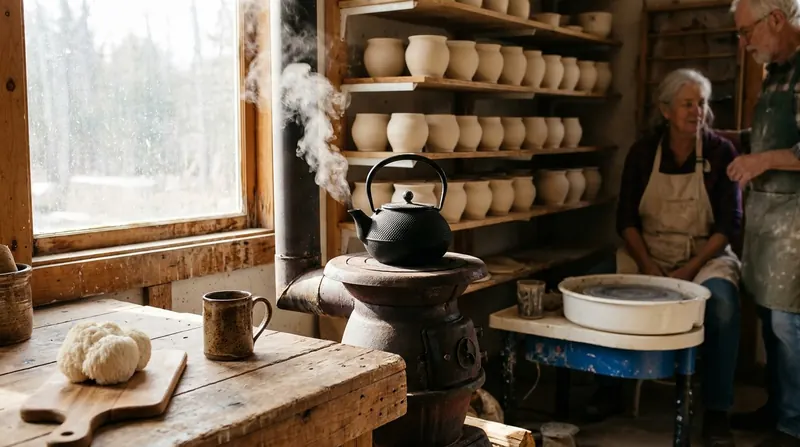
The kettle on my studio stove is older than my daughter.
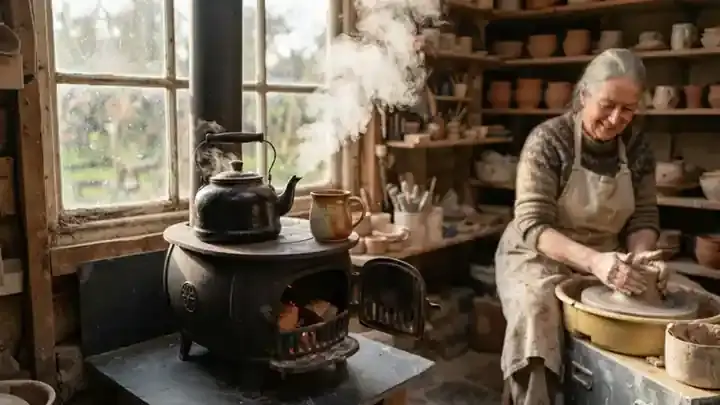
It's black cast iron, heavy as a bag of clay, and it has sat on the same woodstove every morning since 1986.
I fill it before I light the stove, and by the time the studio is warm enough to touch wet clay, it's singing. That's how my days have started for forty years.
This column is about that kettle, and about a small box of coffee packets a friend left next to it last spring. It's also about a man's name I couldn't find.
Forty years of mugs for other people's hands
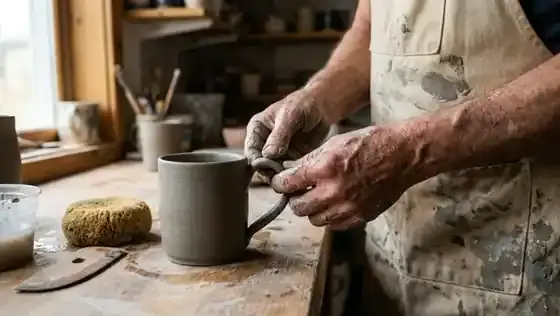
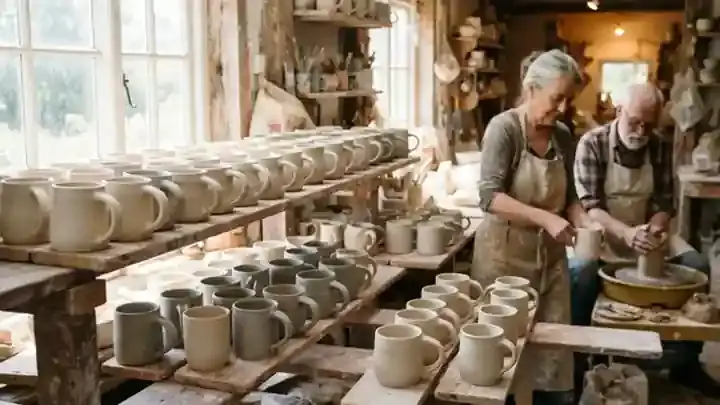
I made pots in Seagrove, North Carolina, for four decades. Mostly mugs: speckled brown stoneware, a thumb rest on the handle, a lip that doesn't dribble.
I've thrown, by my own rough count in the kiln log, something over sixty thousand mugs. Every one of them was made for somebody else's hands.
That's not a complaint. It's the job.
You pull a handle and think about the knuckles that will hold it, a man's thick fingers or a grandmother's thin ones.
Forty years making mugs for other people's mornings, and I never once made one with my own morning in mind.
I drank out of a seconds mug with a glaze run on the side.
I retired at sixty-five, which for a potter means you stop doing the festivals every weekend and only do the big one in November. You never really stop.
My wife Marian says I retired from the money, not from the clay. She was a school librarian for thirty-one years, so she knows the difference between a job and a habit.
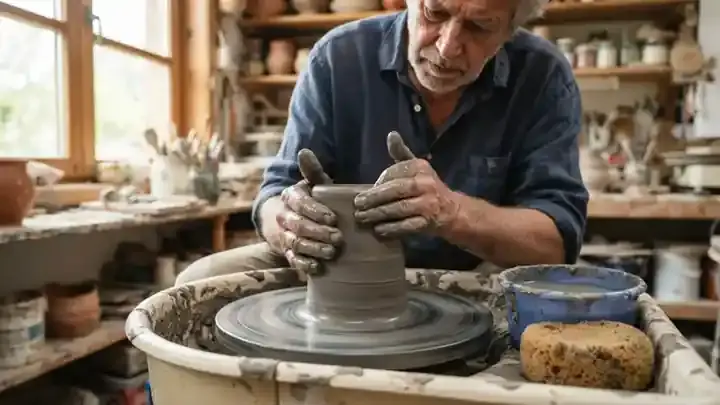
Most mornings now, I'm in the studio by seven. Kettle on the stove, the radio on low, a few pieces on the wheel, and the good kind of quiet until lunch.
The man who bought a mug every October
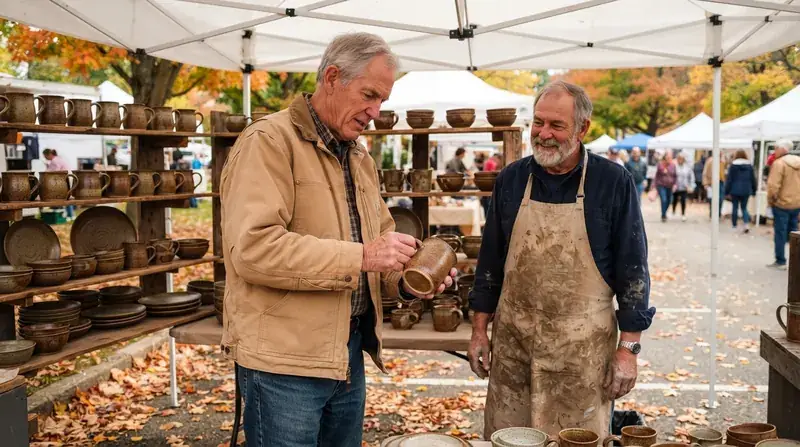
Every October for thirty years, a tall man in a Carhartt jacket came to my booth at the fall kiln opening. He picked one mug, always brown, and paid in cash.
He told me once he gave them to his sons-in-law at Thanksgiving. Over thirty years he'd had four sons-in-law, so there's a lot of my brown stoneware in the Piedmont.
Last fall he walked up to the table, put out his hand and said, "Harlan, you're looking good." And I stood there with my mouth open like a kiln door.
I knew his face better than I know some cousins. I knew his truck, his laugh, the way he turned a mug upside down to read my stamp.
His name simply would not come.
It was on the tip of my tongue the whole time, like a word you can feel the shape of.
I said, "Good to see you, my friend," which is what you say when you've got nothing.
He bought his brown mug. I wrapped it in newspaper.
Twenty minutes after he left, while I was making change for somebody else, it arrived: Talley. Walt Talley.
It's a small thing. I know it's a small thing.
Everybody over sixty has a story about the name that showed up twenty minutes late.
But it bothered me all the way home, and Marian noticed. She didn't say anything until supper, when she asked, "Who didn't you remember today?"
That's the thing about being married to a librarian for forty-two years. She doesn't need you to tell her the story; she can read it off the spine.
A tally in the margin of the kiln log
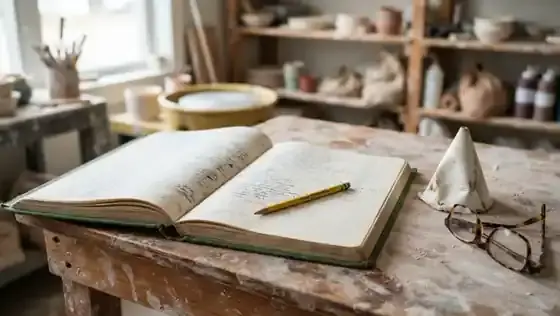
Potters keep kiln logs. Mine is a green clothbound ledger with cone numbers, firing times, which shelf held what, and notes like "cone 10 down at 11:40, glaze ran on the left."
I've filled eleven of those ledgers since 1984. They are the closest thing I have to a diary, and they are honest, because a kiln doesn't care how you feel.
The night after the festival, I opened the current one and drew a little column in the margin. Every time a word or a name went missing, I'd put a tick.
Not the big things; I wasn't losing big things. The small things: the name of a glaze I'd mixed a hundred times, the word "bisque," where I'd set my trimming tool.
The first week I made fourteen ticks. That number meant nothing on its own.
A kiln log is only useful when you have the last firing to compare it to.
So I kept going. Fourteen, then eleven, then sixteen in a week when Marian's sister was visiting and the house was loud and I slept badly.
I want to be plain about this: I am not writing about a medical finding, and nobody handed me one.
My clinician listened, asked good questions and told me to keep living like a man who's busy.
She also told me what I already half knew.
Sleep, walking, people, and having something to do with your hands do more for a clear head than anything you can buy in a box.
I've got the hands part covered. The rest I had to look at honestly, and the first thing I had to look at was the coffee pot.
Three pots of coffee and a trimming tool that chattered
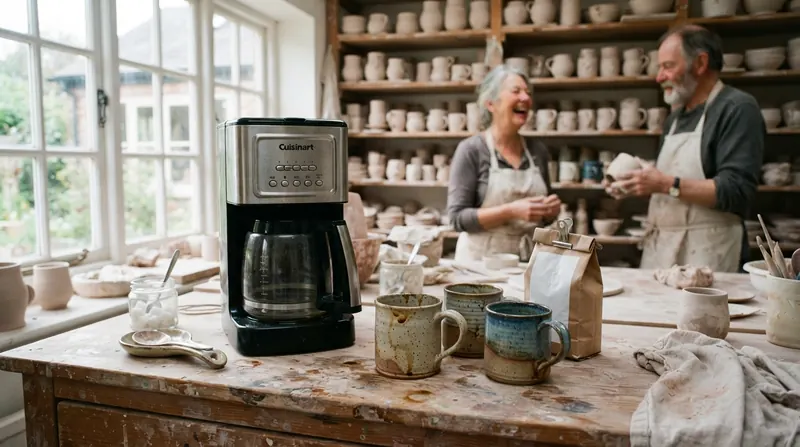
I drank drip coffee from a twelve-cup machine. One pot by nine.
A second pot by noon. Some days a third, reheated, around two, when the afternoon got heavy.
I never thought of it as a lot. Potters drink coffee the way fishermen drink coffee: it's warm, it's there, and the work goes better with a mug next to it.
But by two in the afternoon, my hands were not the hands I wanted on a trimming tool.
Trimming is the fine work, shaving a foot ring on a leather-hard pot with a sharp loop.
If your hands buzz, the tool chatters. You get a rippled foot ring, a little washboard pattern, and the pot goes on the seconds shelf.
I had a lot of rippled foot rings that winter. I blamed the clay, then the tool, then the humidity, and finally Marian asked how many cups I'd had.
The US Food and Drug Administration, it turns out, has a plain page on this.
It cites 400 milligrams of caffeine a day as an amount not generally associated with negative effects in most healthy adults. [1]
The same page says a 12-ounce cup of brewed coffee can hold anywhere from 113 to 247 milligrams. Too much, it says, can bring jitters, a faster heartbeat and sleep disruption.
I did the arithmetic on a scrap of newsprint. Two and a half pots of strong drip coffee was not a small number.
My hands had been telling me for a year; I'd been blaming the clay.
What I didn't want
I'll tell you what I was not going to do, because if you're like me, you've already decided what you're not going to do.
I was not going to quit coffee.
I've had coffee every morning since I was fourteen and working in my uncle's sawmill, and I was not going to start drinking hot water with lemon.
I was not going to buy a bottle of something with a scientist on the label and swallow it with water.
I don't trust a jar that promises more than the clay does.
And I was not going to add anything. If I was going to change one thing, it had to replace something I was already doing, not sit on top of it.
Replace, don't add. That's the rule I wrote at the top of a new page in the kiln log, and it's the rule this whole column hangs on.
I'll add one more thing I didn't want: I didn't want to be sold to.
I've sold pots for forty years and I know every move a table can make on a customer.
So when this all started, I read every line on every box as if I were the man behind the table and somebody else was selling to me.
Dee, the glaze chemist with mushrooms in her garage
Every Thursday, a dozen of us old potters meet at the co-op studio off Highway 705 to mix glazes, fire the big gas kiln and argue about cone temperatures.
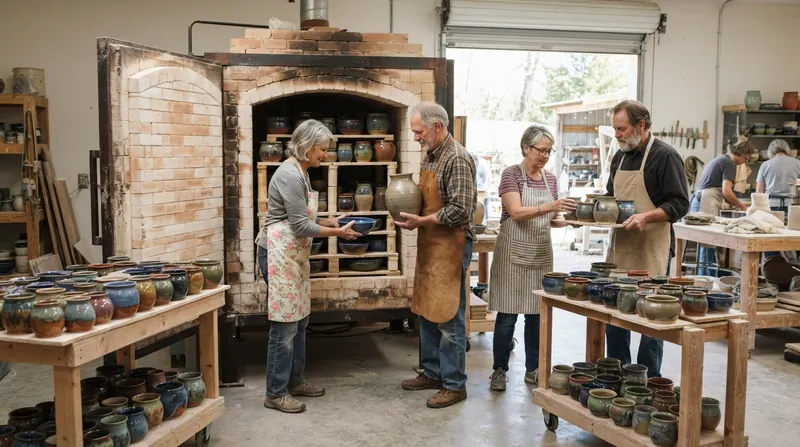
The person who keeps us honest is Dee Amsel. She's seventy-one, she taught high school chemistry for thirty-four years, and she can tell you why a celadon crazes.
Dee weighs glaze materials on a triple-beam balance to a tenth of a gram.
She writes every recipe on an index card in green ink, and she has never once let me eyeball a batch.
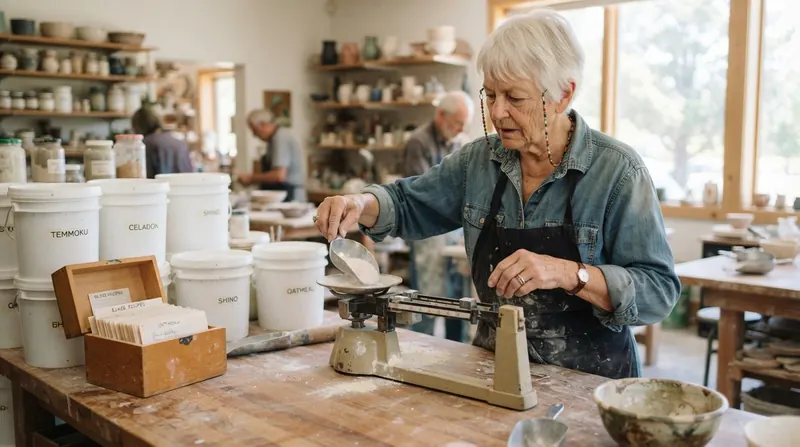
Two years ago, Dee started growing mushrooms in her garage. Oyster first, then shiitake, and last winter a shaggy white one that looks like a frozen waterfall: lion's mane.
She grows them on blocks of sterilized hardwood and grain in a little plastic tent with a humidifier.
She brings them to the co-op in a paper sack and makes us take them home.
"You fry it in butter like crab cakes," she told me the first time. It does taste a little like crab, which surprised me more than anything has surprised me in years.
In February, I told her about Walt Talley's name, the tally in the margin and the trimming tool that chattered. I told her the way you tell a chemist: just the data.
She listened the way she listens to a glaze that won't behave. Then she said, "How many pots of coffee, Harlan?"
And I told her the truth, which was two and a half.
Ten packets on the wedging table
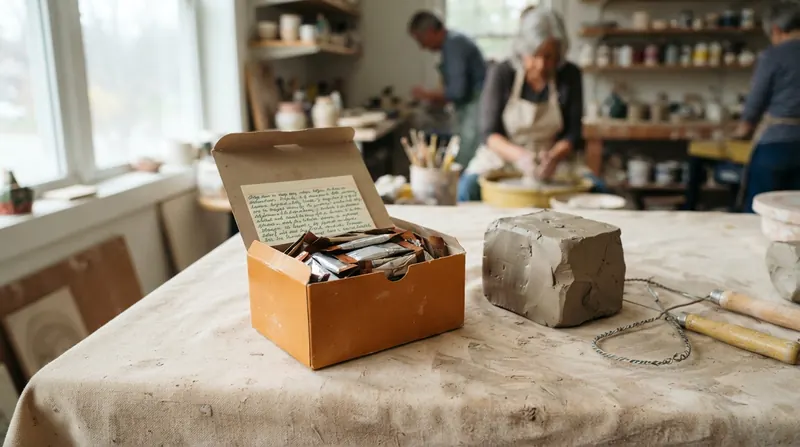
The next Thursday, there was a small orange-and-tan box on my wedging table at the co-op. Ten packets inside.
Dee's green-ink index card was tucked under the lid.
Did you find the box, or did you wedge it into a pot?
6:48Found it, and I've read the back three times. You underlined "in place of."
6:51Because I know you. You'd drink it on top of the two pots.
6:52Fair. Second pot is retired as of tomorrow, and the kettle gets the job.
6:55What I liked about Dee's card was that it didn't promise anything.
It told me what was in the box, how to use it, and which habit it was supposed to take over.
That's a recipe card, not a sales pitch. I've been reading recipe cards my whole working life, and I know the difference.
It's also worth saying: Dee doesn't sell anything. She buys the box with her own money, and she drinks one most mornings herself.
"I grow the mushroom for the frying pan," she told me later. "I buy the packet because I'm not going to grind dried mushroom into my coffee at six in the morning."
Reading the box the way I read a glaze recipe
A glaze recipe is a list of materials and amounts that add up to a hundred. If a recipe doesn't add up, or hides an amount, you don't fire it.
So I read this box the same way.
Line one: Arabica coffee. Real coffee, not a substitute.
The seller's own words are "a bold, full-bodied Arabica roast," and its page says plainly, "This is real coffee, with caffeine."
Line two: organic CoffeeBerry® whole coffee fruit extract. That's the red fruit around the coffee bean.
The seller says it supplies part of the caffeine.
Line three: 2,000 milligrams of organic mushroom powder per serving, lion's mane and cordyceps together. The page says the mushrooms are "dried and milled, never extracted."
Here is where I stopped, the way I'd stop at a glaze recipe that says "frit, 30 parts" without saying which frit.
The box does not say how the 2,000 milligrams split between the two mushrooms.
It could be half and half. It could be mostly one.
That's not a scandal; lots of blends are printed that way. But a careful reader should know it before reading any study.
Line four: 400 milligrams of beta-glucans. Those are fibers found in mushroom cell walls.
The box lists the number; I'm just repeating it.
Line five, the one I read twice: "Contains 110mg caffeine per serving." It's printed on the front of the box and on each packet.
The seller's page doesn't repeat the number, so I'm going by the box.
Line six: a packet weighs 5.8 grams. Ten packets, 58 grams.
A small box for $28.99, which works out to about $2.90 a cup. I'll come back to the price; it's not cheap.
And then the line every honest box carries in small type: these statements have not been evaluated by the Food and Drug Administration.
I respect a box that prints that line where you can find it. It's on the front of the packet, along the bottom edge, in type I could read without my glasses.
The seller also says, and I'll quote rather than paraphrase, that its mushrooms are "organically grown and processed in our own BRCGS AA-rated, cGMP facility in California."
It adds that every harvest and product "is tested in our own laboratory, then again by a third-party lab, for heavy metals and other contaminants."
I can't check that from my studio, so I'm reporting what they print.
Three columns beside the printed panel
At Dee's kitchen table, we turned a sheet sideways and gave it three columns.
This is another scene in the dramatized account, but the reading exercise is one you can do with the box in your own hands.
The first column was for what the seller actually printed. The second was for what I wanted to ask, and the third was for what I was tempted to assume.
Dee liked the third column best. She said it was where most of my glaze mistakes would have gone if I'd been keeping one all these years.
Under the first heading, I copied the serving directions without improving them. One serving a day stayed one serving a day, even when I was curious about the mushroom.
Under the second, I wrote the question about the blend's split. The answer stayed a question, because neither a photograph of a mushroom nor a friendly description supplies a missing amount.
Then I started filling the last column. I'd nearly written that the beta-glucan number was something to add to the mushroom number, as though they were separate scoops going into the mug.
But the seller describes those beta-glucans as contained in the whole mushroom powder. I crossed out my addition and copied the wording instead.
That's the sort of small reading error that can make a label look fuller than it is. A number inside a total isn't another ingredient beside that total.
The same went for the coffee fruit. I could find its name, but I couldn't find a printed amount, and the name didn't give me permission to supply one.
Dee slid the paper back across the table. "Leave some white space," she said, which is advice she has never given me about a kiln shelf.
White space turned out to be useful. It meant I could like the idea of this coffee without pretending I had a complete formula for everything in it.
I also kept the seller's quality descriptions in their own corner. A statement about where something is grown answers a different question from how much of each mushroom is in a serving.
Testing language answers a different question again. It doesn't fill the blank beside the lion's mane amount, and it doesn't turn the finished coffee into the material used in a research paper.
If I wanted more detail, I could ask the company which document supported a particular statement. Until I had that answer, my notes needed to say "seller states," not "Harlan checked."
Marian brought our mugs in and looked over the sideways sheet. She said it resembled the library's order forms, except library order forms rarely had a brown ring through the middle.
I folded the sheet into the kiln log rather than copying only the attractive parts.
The unanswered questions belonged with the directions, because both would matter if I decided to buy another box.
That left us with a manageable next job. We could read the research with the actual label beside the laptop, instead of letting the research write a better label in our heads.
What the research on lion's mane actually measured
Dee taught chemistry for thirty-four years, and her first rule for any claim was: find the paper, and find the dose.
So that's what we did, at her kitchen table, with her laptop and my reading glasses.
There aren't many good studies of lion's mane in people. There are a handful, they're small, and they used amounts that need to be compared with what's actually in a cup.
That's the study people point to.
In a 12-week placebo-controlled trial of 31 healthy adults over 50, a daily lion's mane fruiting-body preparation was associated with higher scores on a standard mental-status test. [2]
Notice the amount: 3.2 grams a day of lion's mane alone.
One Om packet has 2 grams of two mushrooms together, and the box doesn't say how much of that is lion's mane.
Notice also what didn't change. The same trial ran a visual-retention test, and that one showed no difference.
Small trials often show a little movement on one measure and none on another.
The second study was a pilot in 41 healthy adults aged 18 to 45. A single 1.8-gram dose was associated with faster performance on a color-and-word task an hour later. [3]
After 28 days on the same supplement, though, the researchers saw only a trend that didn't reach statistical significance.
The authors themselves asked for caution, and so do I.
Dee drew that chart on an index card before I drew it here.
She tapped the third bar with her pencil and said, "That's two mushrooms, Harlan, so don't you dare call that a dose of one."
So I won't.
What I can say is that the packet puts lion's mane in a cup I was going to drink anyway, in an amount the box doesn't break out, and the studies are small and preliminary.
If anybody tells you a coffee packet will do what a 3.2-gram study dose did in a lab in Japan, walk away from that booth. I wouldn't sell a pot that way.
The coffee fruit study, and why it's a blood test
The CoffeeBerry® line on the box sent us looking for one more paper. Dee found it in about four minutes, which is how long it takes her to find anything.
In a single-dose study in healthy adults, about ten per group, 100 milligrams of whole coffee fruit concentrate raised blood levels of a protein called BDNF by about 143 percent over two hours. [4]
Green coffee caffeine and grape seed extract, in the same study, moved it about 31 percent. The authors called for larger studies.
Here's how Dee read it to me: that's a blood test, not a memory test. Nobody in that study was asked to remember a name.
They had their blood drawn.
And again, the box doesn't say how much coffee fruit extract is in a packet. So the study tells you the ingredient is interesting, not what your cup will do.
I put both of those sentences in the kiln log, side by side, the way I'd write "test tile looked good" next to "but only fired once."
How much caffeine is in one mug
This was the part that mattered most to me, because the coffee pot was the real problem. If the packet had more caffeine than my drip coffee, the whole plan was backwards.
The NIH's center for complementary health keeps a plain page on energy drinks. It lists about 100 milligrams in an 8-ounce cup of coffee and about 35 in a 12-ounce cola. [5]
The same page says an energy shot can hold 113 to 200 milligrams. And the FDA page I mentioned says a 12-ounce cup of brewed coffee runs 113 to 247. [1]
So one packet is roughly one ordinary cup of coffee. Not less, not much more.
It is not a way to cut caffeine; the seller says so itself.
What it could be, for a man drinking two and a half pots, was a way to cap the day.
One mug of drip at seven, one packet from the kettle at ten, and no third pot at two.
That works out to roughly 210 to 260 milligrams a day by my arithmetic, depending on how strong Marian makes the morning pot.
Well under the 400 the FDA cites, and well under what I'd been drinking. [1]
European regulators reached a similar number. The European Food Safety Authority concluded in 2015 that daily intakes up to 400 milligrams don't raise safety concerns for healthy adults. [6]
Both agencies add that some people are more sensitive and that anyone who takes medicines should ask a health care provider. Dee wrote that on the bottom of her index card, too.
What's in the packet, and what it is not
I like to know what a thing is not as much as what it is. A glaze that isn't food-safe has to say so.
So here is what this packet is not, in plain words.
It is not something you swallow with water. It's coffee powder.
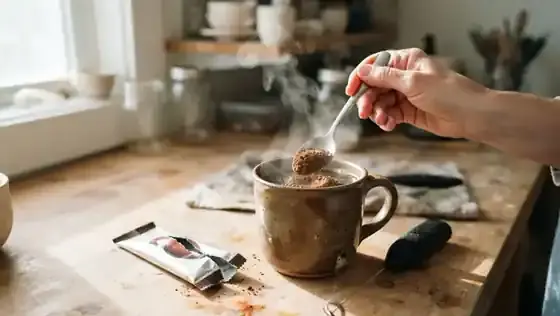
You tear the packet, pour it into a mug, add water from the kettle and stir.
It is not decaf. At 110 milligrams of caffeine a packet, it's as strong as a normal cup.
If your clinician told you to cut caffeine, this isn't the way.
It is not a nighttime drink. The seller itself calls it "a morning coffee."
I drink mine before eleven and never after lunch.
It is not an extract of the mushroom. The seller says the lion's mane and cordyceps are "whole mushroom powder, dried and milled, never extracted," the fruiting body and the mycelium both.
It is not a promise. Nothing on the box says it will bring back a name.
The claims it does make, "supports focus" and "supports energy," sit next to the FDA line.
And it is not a reason to skip the things that matter more.
The walk after supper, the Thursday co-op, a decent night's sleep, and the clinician twice a year.
How I make it: kettle, mug, and a little frother
The seller's directions are simple:
one packet, or about a tablespoon from the canister, in eight ounces of hot water or milk, "blend well with a hand frother," hot or cold, one serving a day.
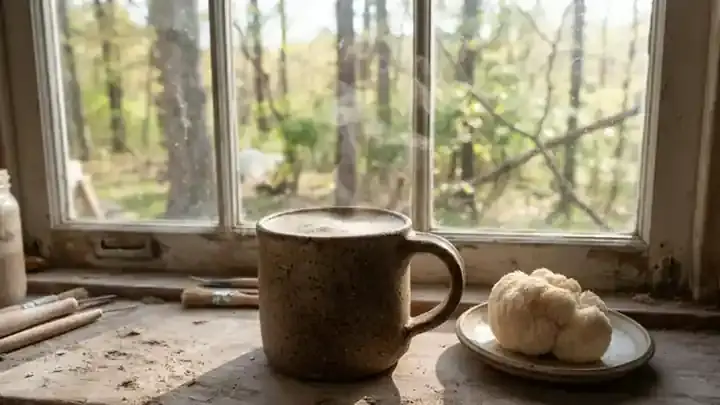
My version: the iron kettle comes off the stove a minute after it sings, so the water isn't quite boiling.
I tear the packet into my own brown mug, pour, and stir with a wooden rib.
Peggy, one of the reviewers on the seller's page, wrote that it "dissolves easy," and she's right.
I tried it without the frother for a week and it was fine, just a little thinner.
Marian bought me a four-dollar battery frother at the hardware store in Asheboro, and now it goes in with a splash of whole milk.
Thirty seconds of buzzing and it looks like a café cup.
What does it taste like? Coffee.
The seller says "it tastes like coffee," and that's the most honest sentence on the page. It's a little earthier than my drip, maybe.
If you'd blindfolded me in the first week, I'd have said "instant coffee, decent brand." After a month, I'd have said "my coffee."
Peggy wrote that she makes it "any flavor I desire from caramel to chi spiced to cinnamon."
I'm not a caramel man, but a pinch of cinnamon on a cold morning is fine by me.
Eight ounces in a mug I made myself
There's a problem with a potter telling you to use a mug.
We make mugs in every size a hand can hold, and almost none of us write the capacity on the bottom.
My brown seconds mug isn't a measuring cup. A generous handle and a wide belly can make a large drink look smaller than it is.
So in this dramatized kitchen scene, Marian handed me the glass measuring cup from the cupboard. "You weigh clay," she said, "but apparently water is a matter of opinion."
We measured the seller's eight ounces into the empty mug with ordinary water first. That showed me where the liquid would sit before I had a hot kettle in my hand.
It left room at the top for stirring. I didn't have to balance a brimful mug across the studio or decide that spilling coffee was simply part of the process.
The mug's size doesn't change the serving. A bigger vessel isn't a reason to open a second packet, and a smaller splash of water doesn't remove any of the packet's caffeine.
That last point matters when you're used to judging coffee by its color. I could make a pale-looking drink in a large mug and still have the same packet in it.
I wanted to stop making that kind of guess. The packet supplied the serving; the measuring cup supplied the liquid amount, and neither needed my artistic interpretation.
For an ordinary morning, I clear a little space before I start. Coffee, mug and a clean spoon sit together, with the clay work left on the other part of the bench.
The frother goes there too, if I'm using it. I don't need to search through a drawer with the kettle waiting, which is how a simple cup becomes a small production.
Then I follow the printed order and blend it well. If I want to compare water with milk, I can change the liquid on another morning while keeping to the seller's directions.
There's no need to make the first cup a contest between cinnamon, milk and every other thing in the cupboard.
I'd rather find out whether I want the coffee itself before dressing it for company.
That's a question about taste and fuss, not a score on anything in my notebook. A cup can be perfectly acceptable and still be more work than somebody wants before breakfast.
I keep the packet box near the kettle rather than beside the drip machine's filters. The location reminds me that this powder belongs in the mug, not in the basket of grounds.
And when the cup is made, I rinse the spoon and put the loose things away. I have enough drying objects in this studio without adding a sticky utensil to the collection.
The useful test is whether the preparation fits your morning.
Can you read the directions, measure the liquid, mix the serving and clean up without turning the counter into another job?
If not, that's information worth keeping. There's no virtue in owning a coffee you won't make, any more than there's virtue in keeping a beautiful teapot whose handle you dislike.
Learning to grow the mushroom myself
I said the mushroom was the part that surprised me. It wasn't the coffee.
It was Dee's garage.
In March she invited me over to see the grow tent.
It's a plastic shelving unit wrapped in clear plastic, a cheap humidifier, a fan on a timer, and six blocks of sawdust and grain.
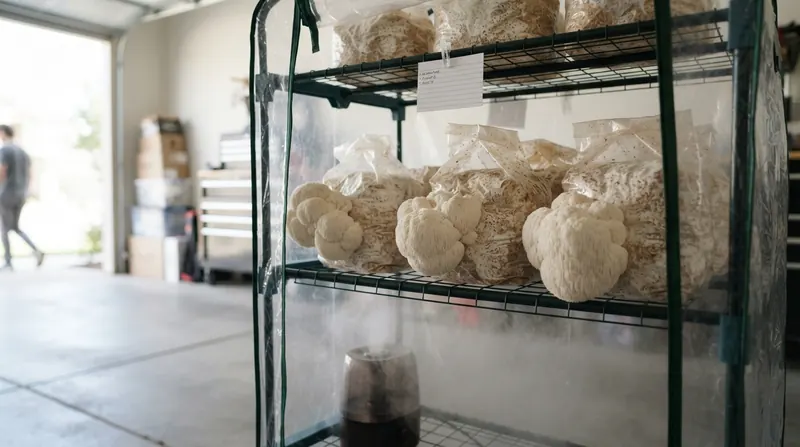
On one block, a lion's mane was pushing out through a slit in the plastic. White, soft, like a little beard of icicles.
Dee said it would be ready in five days.
"The part you eat is the fruiting body," she told me, pointing. "The white threads all through the block, that's the mycelium, and the box in your studio has both."
That's what the seller means by "fruiting body and mycelium." The mushroom you see, and the root-like network you don't.
I'd never thought about mushrooms having a part you don't see.
Potters understand that, actually. A pot is mostly what happened in the kiln where nobody was watching.
Dee gave me a block of my own in April.
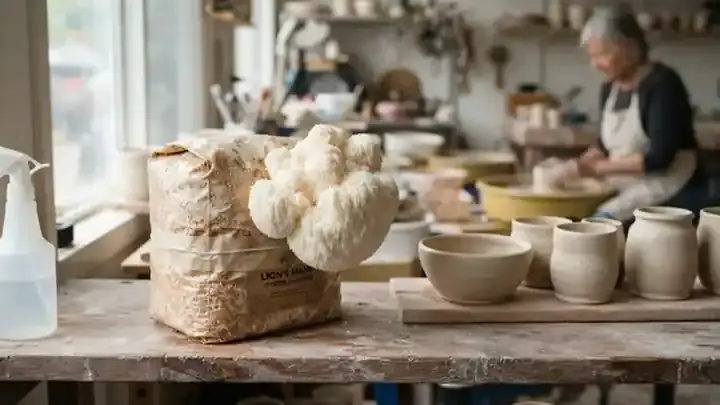
I set it on a shelf in the studio, away from the kiln, misted it twice a day and wrote it in the log like a firing.
I've harvested four mushrooms off that block and two more since. I want to be clear that the mushroom in my skillet and the powder in my mug are two separate things.
I grow it because I like growing things and because I like a new skill at sixty-seven.
The packet is how I get it in a cup on a Tuesday when there's nothing on the shelf.
What other buyers wrote on the seller's page
The seller's page shows 4.6 stars from 398 reviews. I can't see all 398 from my studio.
What the page shows up front are three customer quotes, and I'm printing them exactly as written.
The portraits next to them are illustrative; the seller doesn't publish photos or hometowns. The words are theirs, typos and dashes included.

I literally love this coffee. No coffee jitters! A calm and focused morning every morning to start my day.

Love the coffee, look forward to drinking it every day, no acidity, doesn't make me crash. I also enjoy the hot chocolate and Matcha.

Guess what? I feel like I'm doing my body good with the Om Mushroom coffee blend and it tastes just like coffee. Never missed my first cup of Joe when I replaced it with Om- because it has coffee in it! Dissolves easy, I can easily make it any flavor I desire from caramel to chi spiced to cinnamon - always add my collagen and I'm good to go-
Read those three the way a potter reads a customer.
Not one of them says it changed her life; they say they like the taste, it dissolves, and it doesn't make them crash.
That's the honest shape of it. People who buy coffee mostly write about coffee.
And Peggy's line, "when I replaced it with Om," is my rule in her words.
Sheila says "no coffee jitters." I'll be careful with that one.
At 110 milligrams a packet, the caffeine is about a normal cup, so if she had jitters before, I'd guess she was drinking more than one.
That's not a knock on Sheila. It's what happened to me.
The packet didn't take the jitters away; drinking less coffee did, and the packet made drinking less coffee easy.
Three quotes chosen by the seller are a small window. I'd rather tell you that than pretend they're a survey.
If you want the rest, the seller's page has them.
The questions I took to the pharmacy counter
Before the first packet, I did what Dee's card said and what the FDA page says: I asked.
I take one daily medicine my clinician keeps an eye on, and I wanted a second set of eyes.
Morning, Harlan, Marian's order is ready. You said you had a question?
9:02A coffee packet with lion's mane and cordyceps. Can I bring you the box?
9:05Bring it. I'll read the label with you and check it against your list.
9:06Coming at ten. I'll bring you a mug, too, brown of course.
9:08
Raj read the box front and back, then looked up the two mushrooms on his computer. He said what a good pharmacist says:
nothing on it jumped out against my list, and caffeine was the ingredient to watch.
He also said that a mushroom powder is a food-type ingredient, but that any supplement alongside a daily medicine is worth mentioning at the next appointment.
So I wrote it on the list for April.
The seller's page says the same thing, which I'll give it credit for: "As a general note, check with your healthcare provider about any supplement."
And it says pregnant or nursing women should ask first.
Raj kept the mug. He said it was the nicest thing anyone had brought to the counter since his daughter's kindergarten drawing.
Eight weeks in the margin of the kiln log
Here is what the kiln log says. I've copied it as written, with the bad weeks left in.
A kiln log that only records the good firings is a lie you tell yourself.
Harlan's kiln log margin, March to May
- Week 1Second pot retired. One drip mug at 7, one packet from the kettle at 10. Headache Tuesday and Wednesday by 2 pm; Marian said that's the third pot leaving. 13 ticks.
- Week 2Nothing. Headaches gone, tally the same, coffee tastes like coffee. Wrote "nothing" four days running and thought about giving the box back to Dee. 15 ticks.
- Week 3First clean foot ring in weeks: no chatter on the trimming tool at 2 pm. Walked with Marian after supper four nights. 12 ticks.
- Week 4Co-op Thursday, named every glaze on Dee's shelf without the index cards. Felt good about it; Dee said "don't get cocky." 9 ticks.
- Week 5Marian's sister visited, house loud, slept badly, skipped two walks. 14 ticks. Wrote it down anyway.
- Week 6Back to the walks. Grandson Eli at the wheel on Saturday; I remembered which shelf held the small bats on the first try. 10 ticks.
- Week 8Clinician in April with the log in my jacket pocket. She read the margin, nodded, and said "keep the walks."
I want to say clearly what that log does and doesn't show.
It shows fewer ticks in some weeks and more in others, and it shows I slept better and trimmed better once the third pot was gone.

It does not show that a mushroom brought back a name. I changed the coffee, the walks, the Thursdays and the sleep, all at once, because that's how a life works.
A kiln log can't separate them.
The seller says that "most people notice benefits in weeks two to four." My week two was "nothing."
My week four was a good Thursday. My week five was bad.
Make of that what you will.
What Marian wanted left in the notebook
After I copied that margin, Marian asked whether I was going to print the ordinary parts too. Not just the starred Saturday, but the afternoon I stayed inside because it was raining.
In this dramatized exchange, she stood with the notebook open on the kitchen counter. She wasn't challenging the numbers; she was asking what a stranger could reasonably learn from them.
A stranger couldn't see the houseguests, the late supper or the radio I left on while I worked. A tick in a narrow column couldn't carry all that by itself.
So I began leaving a little room beside the ticks for plain descriptions. "Visitors," "late night" and "walked after supper" were more useful than a word like "better."
Write what happened before deciding what it means.
That's something a potter ought to know, but I needed a librarian to say it in the kitchen.
The same rule worked for the coffee.
I could write when I made a mug and whether I made more coffee afterward, instead of declaring that I'd followed my rule because I meant to.
An extra cup at somebody else's table still belonged on the page. It didn't disappear just because I hadn't made it in my own studio.
I didn't need another impressive-looking total. I needed a record I could read without explaining away the inconvenient lines, including the ones where the second pot crept back into my thinking.
For anyone using an ordinary notebook, I'd keep that practical distinction. A note about a drink is a note about a drink; a note about a missed name is a separate observation.
Putting them on neighboring lines doesn't connect them. The page can hold both without claiming that one explains the other.
Nor did I want to turn a conversation with Marian into a daily inspection.
If I couldn't find a word at supper, she didn't need to reach for a pencil before passing the potatoes.
We agreed that I would write my own notes. She could tell me something she noticed, but she wasn't going to become the keeper of a score I checked over her shoulder.
That was a relief for both of us. A kitchen table ought to have room for supper without every pause in the conversation becoming an entry.
Before an appointment, I could choose a few concrete questions from the page.
I wanted to describe what concerned me, when it happened and what I was doing, rather than arrive with my own explanation already settled.
I could bring the actual coffee box too. That would give the clinician the printed ingredients and directions, instead of my description of something Dee left at the co-op.
The notebook was there to help me speak plainly, not to award the coffee credit. It wasn't a reason to postpone asking about something that worried me, either.
Marian closed it and put it beside the car keys. The kiln log had finally found a second job that didn't require pretending it was a laboratory book.
And that left more room for the part of Saturday I actually wanted to write about: Eli at the wheel, waiting for me to hand him a small round board.
Eli at the wheel, and the shelf with the small bats
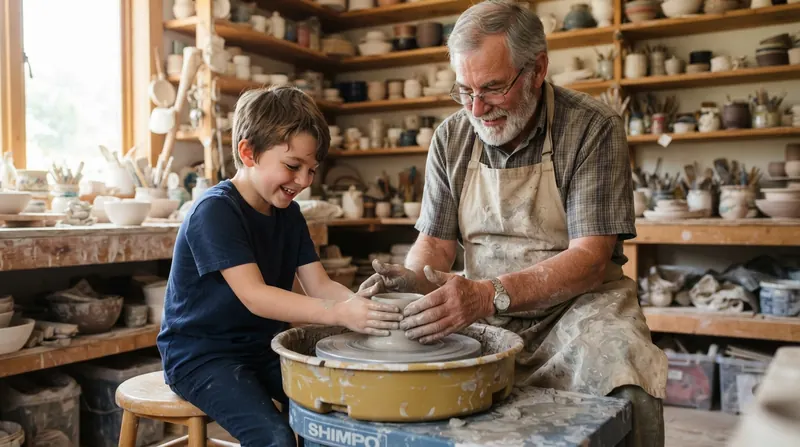
My grandson Eli is eight. He comes out on Saturdays when my daughter Claire drives over from Raleigh, and he wants to "make a bowl for Mom."
Every bowl an eight-year-old makes is a slightly lopsided cylinder, and every one of them is perfect. Claire has eleven of them on a shelf in her kitchen.
In week six, Eli asked for the small bats, the little round boards you throw small pots on.
I walked straight to the right shelf, north wall, second from the bottom, and handed him one.
That sounds like nothing. In February I'd stood in the middle of the studio for a full minute trying to remember where I kept them.
I wrote it in the margin with a star, not a tick.
Eli says Grandpa's coffee "smells like the woods." Is that the mushroom one?
8:14It is: one packet at ten instead of the second pot. Your mother approves.
8:20Mom approves of anything that isn't the third pot. Are you still walking after supper?
8:21Four nights out of seven. Tell Eli his bowl is out of the bisque and ready for glaze.
8:24Claire is the one who worries about me, in the way daughters do. When I told her about the festival and Walt Talley, she didn't laugh.
She said, "Dad, you've always been terrible with names. You called my prom date Kevin for two years, and his name was Brian."
That was fair, and it helped.
What readers asked after the spring column
When a shorter version of this ran in the co-op newsletter in May, I got more mail than I've ever gotten about pottery.
Most of it asked the same four questions, so I'll answer them here.
"Isn't it just expensive instant coffee?" Partly, yes.
At $2.90 a cup from the small box, it costs more than any coffee I'd ever bought. The canister brings it to about $1.40.
"Can I just put it in my coffee maker?" No.
It's instant powder; it goes in a mug with hot water or milk. The seller sells a different product meant for brewing, which I haven't tried.
"Will it keep me up?" It's 110 milligrams of caffeine, about a cup of coffee.
If a cup of coffee at three keeps you up, this will too. I stop before lunch.
"Did it bring back the name?" Walt Talley's name came back twenty minutes later at the festival, before I'd ever heard of the box.
Names come and go. I just keep fewer pots of coffee between them now.
The comments above are illustrative, gathered from the kinds of notes readers sent the newsletter. And yes, Walt Talley does read the co-op newsletter.
He found the column before I could warn him.
He came by the studio in June to buy a mug early, for a fifth son-in-law.
I said "Walt" before he'd gotten out of the truck, and we both laughed about it for a good while.
Two old potters, one recorder and a pot of nothing
In September the co-op started recording short conversations for its website, two members on a porch talking about whatever they're working on. Dee and I were episode six.


Co-op Porch Sessions · Episode 6
Two Potters, an Iron Kettle and a Box of Ten Packets
Harlan
host
Dee, the co-op wants to know why a chemistry teacher left a box of coffee on my wedging table instead of just telling me what to do.
 Dee
guest
Because I've been telling you what to do for twelve years and you've listened twice. A box with an index card you'd read, because you read everything with a list of ingredients on it.
Harlan
host
I did read it, three times. And then I went and found the studies, and the doses don't match the packet.
Dee
guest
They don't, and I never said they did: the study in Japan gave more than three grams of lion's mane a day, and your packet is two grams of two mushrooms together. I told you to replace the second pot, not to expect a study result in a mug.
Harlan
host
So what does it do, in your honest opinion as a chemist?
Dee
guest
It's a decent cup of coffee with a mushroom I like in it, and it took the place of a pot of coffee that was making your hands shake. Whatever happened in your margin, you did with your feet, your Thursdays and your sleep.
Harlan
host
And the mushroom in your garage? Why grow it if you buy the packets?
Dee
guest
Because growing it is the best part: you check it every morning, you write it down, you watch it change. It's like watching a kiln through the spy hole, except you get to eat it.
Harlan
host
What would you tell somebody who just blanked on a name at a craft fair?
Dee
guest
Write it down, count your coffee pots, and tell your clinician about both. And if you want a packet in the mug, put it there instead of something, never on top of it.
I cut the part where Dee laughed so hard at my Kevin-and-Brian story that she spilled her mug. Some things stay on the porch.
Choosing a box without buying a story
Before the price lines, there's a decision I had to make standing at my own shelf.
Was I choosing coffee I wanted to drink, or buying another chapter of a story I liked?
It's easy to confuse the two when a friend brings something into your life.
Dee could have left a tin of ordinary coffee with that green card, and I would have paid attention.
So I tried taking Dee out of the purchase for a moment. The question became whether the printed product, with its unanswered questions still attached, suited the morning I actually had.
I would not ask a cup of coffee to earn its place by returning a name.
That isn't a fair buying test, and nothing in my margin could make it one.
I could ask whether I liked making it, whether I wanted the taste again and whether I was comfortable paying for the blend.
Those were decisions I could actually make at the counter.
The small box and the larger canister answered different practical questions. Packets gave me a counted serving I could take along; the canister belonged on a shelf with the measuring spoon.
A lower cost per serving wasn't the whole purchase. I still had to pay for the container, make room for it and use what I bought.
I've made that mistake with glaze materials. A large sack looks economical until you realize the recipe you like uses very little and the sack will be underfoot for years.
Coffee isn't glaze, but the buying habit travels. A larger amount is only useful if it's an amount you want.
For a reader comparing the choices, I'd start with the seller's serving count rather than guessing from the photograph.
Boxes and canisters can look enormous or tiny depending on the mug beside them.
Then I'd look at the whole checkout amount. Delivery charges and the choice between a single order and a repeating one belong in the decision, not in a surprise after it.
Free shipping wouldn't make me add something I hadn't planned to use.
I'd compare the total for the coffee I wanted with the total for the extra goods, then leave the unwanted goods out.
And I wouldn't select a subscription just because the first screen made it convenient.
I'd read the amount charged, how often it repeats and how to change it before agreeing to another delivery.
The same goes for a box bought for someone else. If Marian wanted a different coffee, my liking this one wouldn't be a reason to replace hers without asking.
Dee offered me a box and a card; she left me the decision. That courtesy is part of the scene worth keeping, even if the coffee never enters your kitchen.
Once I'd chosen, I'd keep the order confirmation with the date and the seller's contact information. The terms below tell you why that paperwork matters;
the empty packet in the wastebasket doesn't tell you when you paid.
None of this requires believing the story ends with everybody buying the same thing. A reader who keeps the percolator after doing the comparison has made a decision too.
I wanted to make mine with the actual box, the actual directions and the actual cost in front of me.
Here are those numbers, without making the coffee carry the rest of my life.
What one box costs, before the button
Here are the numbers I'd want at a booth before I paid. The small box is $28.99 for ten packets, about $2.90 a cup.
The canister is $41.99 for thirty servings, about $1.40.
Shipping is free on orders of $45 and up to the contiguous US, so one canister alone falls just short.
The seller also offers a subscription that ships free and can be paused or canceled.
I bought the small box first, the one Dee had given me, to be sure I'd drink all ten.
After that I bought the canister, and the tablespoon from the tin works just like the packet.
10 single-serving packets · about $2.90 a cup · read the 100-day terms below
The 100 days, in plain words
The seller calls it a "100-day satisfaction guarantee." I read the actual policy page, and I'll give it to you in plain words, because the details matter more than the headline.
"At our team's discretion" means they decide between a refund, an exchange or a replacement. That's fairer than many policies I've read, but it's not an automatic check in the mail.
The seller's own phrase for the idea behind it is "Mushrooms take weeks, so we give you months."
A hundred days is long enough to drink a canister and three small boxes, which is a fair trial.
The seller also prints that its mushroom powder is USDA certified organic and that every production lot is tested for gluten at 10 parts per million, below the FDA's line of 20 for a gluten-free label.
Short answers to the questions Dee gets at the co-op
Short answers, the way Dee would give them
How do you make it?
One packet, or about a tablespoon from the canister, in eight ounces of hot water or milk, then stir or use a hand frother, per the seller. I use water just off the boil from the kettle and a splash of whole milk.
What does it taste like?
Coffee: the seller calls it "a bold, full-bodied Arabica roast." To me it's a good instant coffee, a touch earthier than my drip.
How much caffeine is in it?
The box front reads "Contains 110mg caffeine per serving," about the same as an ordinary 8-ounce cup of coffee by the NIH's figure of roughly 100.
Is it a way to cut caffeine?
No, the seller says plainly that it's "real coffee, with caffeine." It helped me only because one packet took the place of a whole pot.
How much lion's mane is in a packet?
The box says 2,000 mg of lion's mane and cordyceps together. It doesn't print the split, so nobody outside the company can tell you the lion's mane amount.
When would I notice anything?
The seller says the caffeine works the same day and that most people notice something "in weeks two to four." My week two was "nothing," and nobody honest can promise more than that.
Can I drink it if I take a daily medicine?
Take the box to your pharmacist and tell your clinician, as the seller's own page and the FDA both advise. Caffeine is the ingredient to mention.
Is it organic?
The seller says the mushroom powder is USDA certified organic, and the box shows the USDA Organic seal.
Where are the mushrooms grown?
At the seller's own indoor farm in California, on organic, gluten-free whole oats, according to its page.
Who makes it, and how do I reach them?
Om Mushroom Superfood, 1395 Park Center Drive, Vista, California. Phone 1 (888) 278-2509, Monday to Friday 8 to 4 Pacific; email hello@ommushrooms.com.
Does it ship outside the US?
The seller's site ships within the US and Canada. Orders to Canada may carry duties.
- You drink more coffee than you'd like and want one cup to take the place of a pot
- You like the taste of plain coffee and don't want to give it up
- You'd rather tear a packet into a mug than swallow anything with water
- You want to read a label with amounts printed on it, including the caffeine
- You'll keep some kind of log, a notebook or a margin, and take it to your next appointment
- You want a promise about names or words; nobody honest can give you one, and the box's FDA line says so
- You're trying to cut caffeine; this has about a cup's worth per packet
- You want to know exactly how much lion's mane you're getting; the box doesn't split the 2,000 mg
- You drink coffee after lunch and sleep poorly; this is a morning coffee
- You're pregnant or nursing, or take a daily medicine and haven't asked your pharmacist yet
Instant coffee packets · lion's mane and cordyceps · one in place of a cup, not on top of one
P.S. Dee's green-ink index card is thumbtacked above my wedging table now, next to the kiln schedule, clay-stained at the corner; if you have a Dee in your life, thank her, and if you are the Dee, leave the box anyway.
P.P.S. Remember the order she wrote, replace, don't add, and read the box first; the packet is the smallest change in this story, and it's the only one that comes in a box.
The full ingredient guide, with a note on coffee, coffee fruit, lion's mane and cordyceps and on reading the advertising around mushroom coffee, is linked at the foot of this page.
First, the people: Harlan Voss is a pen name. Dee, Marian, Claire and the co-op are composites, the way small-town columns have always been written.
Everything about the coffee itself, its label, its price, its directions, its reviews and its return terms, comes from the seller's own pages, read in October 2026.